Circularity in Interior Design: From Good Intentions to Practical Action
CIRCULARITY IN INTERIOR DESIGN NEEDS PRACTICAL SOLUTIONS
Circularity in interior design is gaining momentum, but turning good intentions into everyday practice remains difficult. During Climate Week NYC, Robin Reigi joined a group of design and sustainability professionals to discuss what is getting in the way. The conversation focused on economics, reverse logistics, market demand, and our tendency to replace products too quickly. Just as important, the group explored practical changes that can help keep materials in use longer.
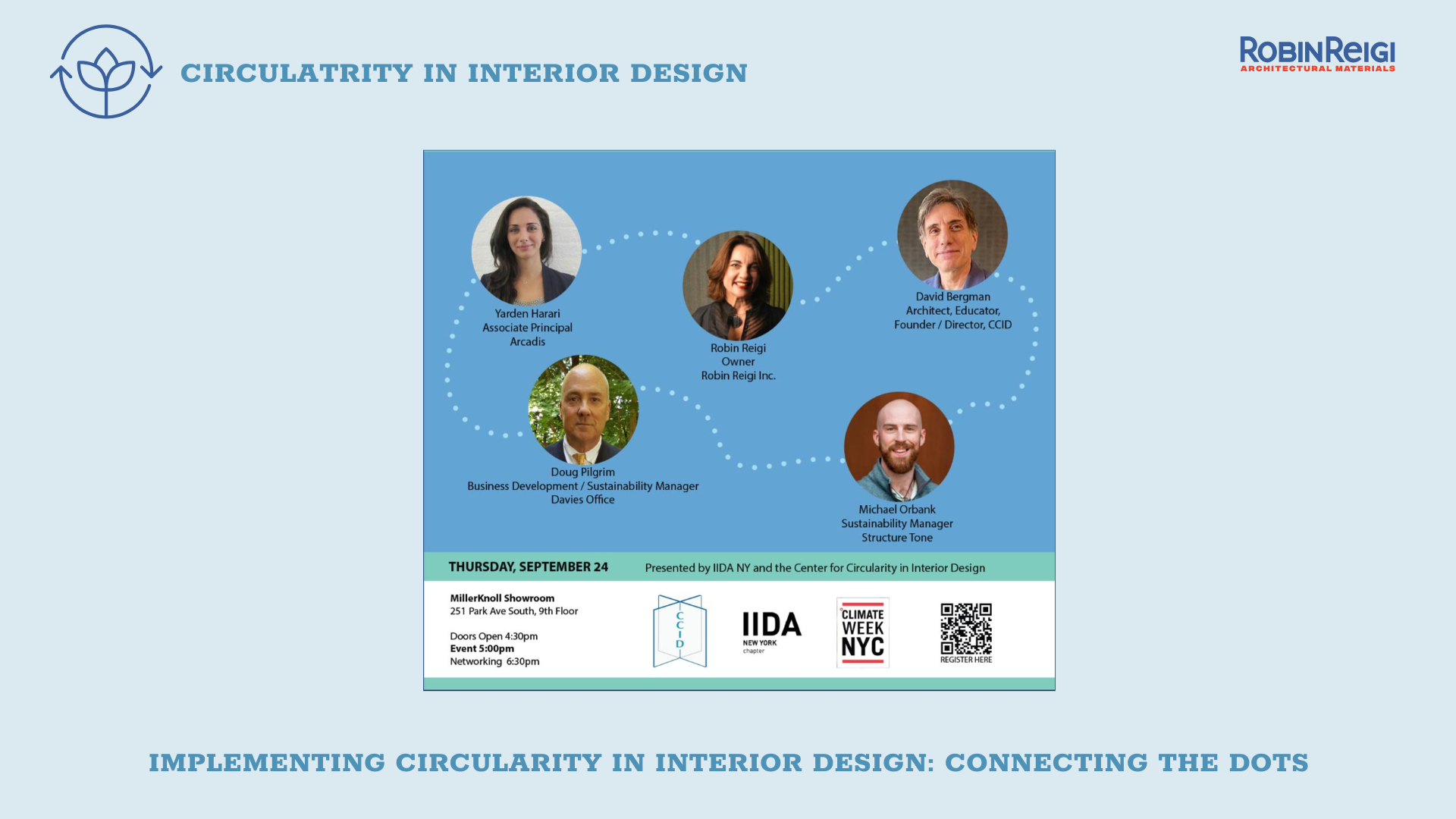
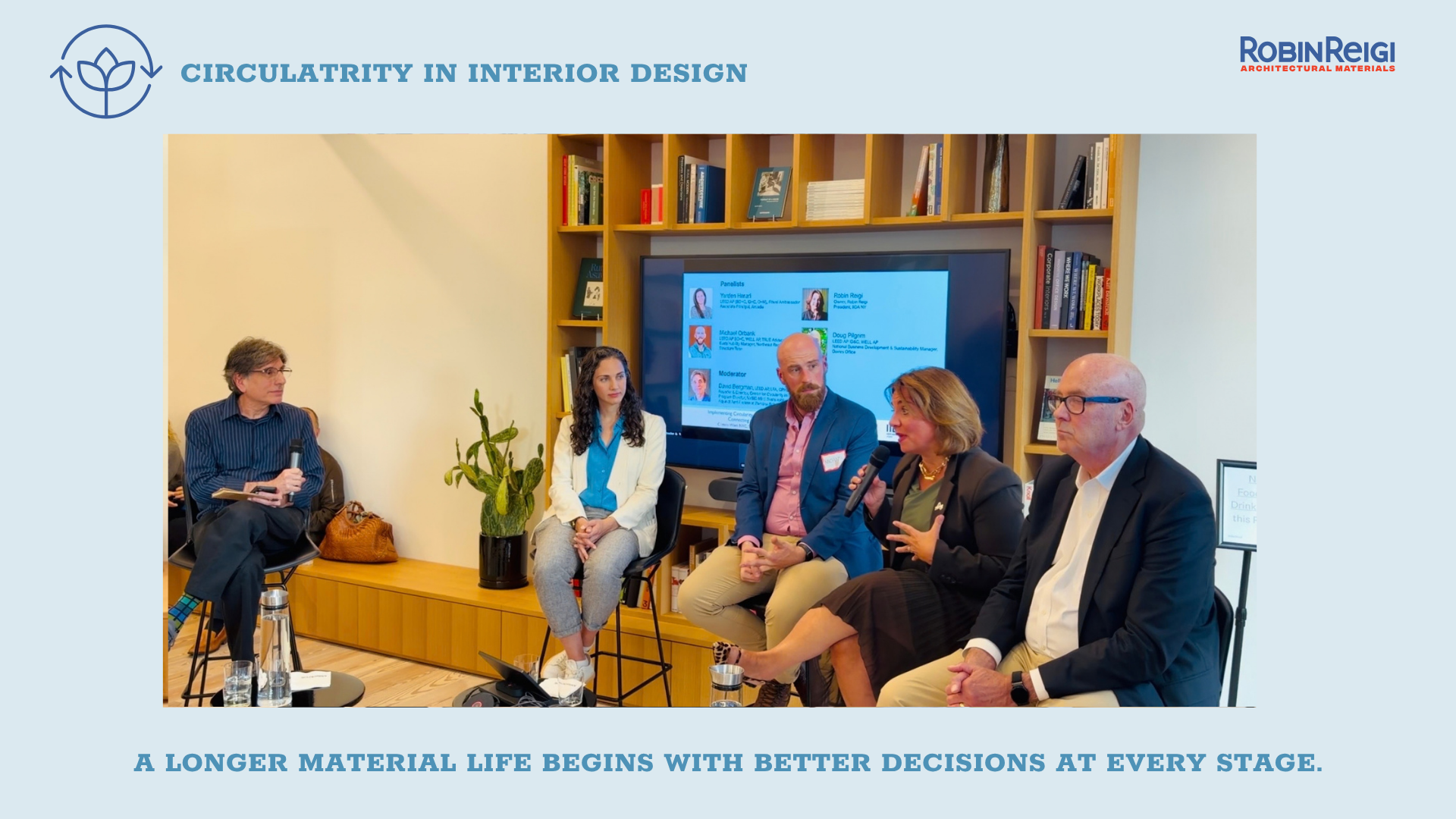
The event was held at the MillerKnoll showroom in New York City. It also celebrated the launch of the Center for Circularity in Interior Design, founded by David Bergman.
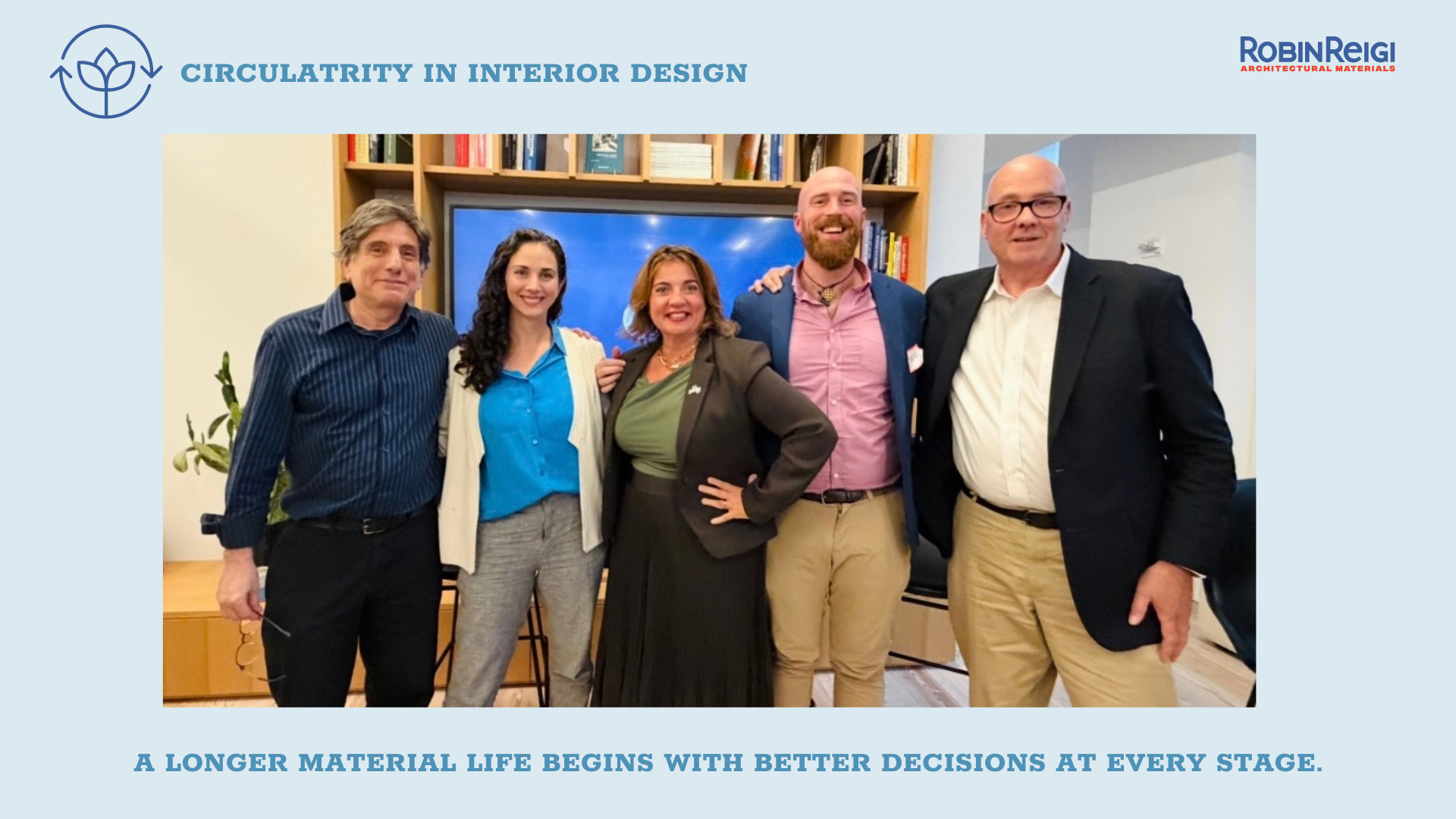
David moderated the discussion, bringing decades of experience as an architect, educator, and advocate for sustainable design. Yarden Harari of Arcadis opened with a case study on circularity before the conversation expanded to the full group. Also participating in the discussion were Robin Reigi, Founder, Robin Reigi, Inc., Michael Orbank, Sustainability Manager, Structure Tone, and Doug Pilgrim, Business Development/Sustainability Manager, Davies Office.
The room was packed, including many visitors in New York for Climate Week. The discussion was candid and highly interactive. There was plenty to say about the obstacles. There was also real optimism about the changes already underway.
WHAT DOES CIRCULARITY MEAN FOR INTERIOR DESIGN?
At its core, circular design asks us to keep materials and products in use for as long as possible.
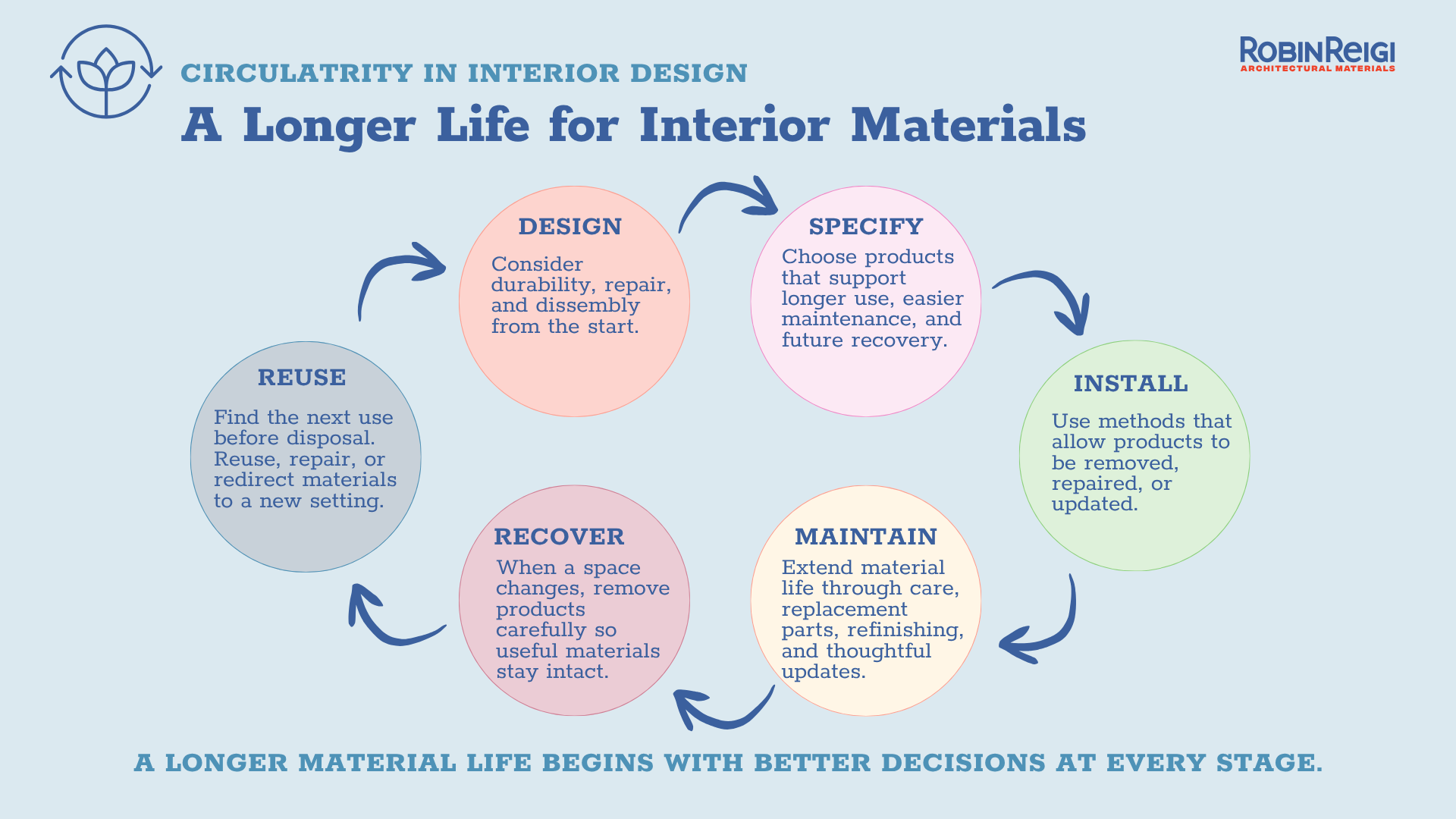
That means thinking beyond the moment when a product is specified and installed. Designers also need to consider what happens when a space changes.
- Can the product be repaired?
- Can parts be replaced?
- Can it be moved to another space?
- Can the materials be separated and reused?
Those questions change how products are designed, specified, installed, and eventually recovered.
The Center for Circularity in Interior Design describes this approach as both a mindset and a mechanism. We can view our interiors as temporary assemblies of finite materials. Those materials can then move through repeated cycles of use rather than heading directly to disposal.
For interior designers and architects, that represents a significant shift in thinking. A product’s first installation becomes one stage of a much longer material life.
Circularity also depends on the systems that connect those decisions. A product can be designed for reuse, but that potential is lost if there is no practical way to track it, recover it, or connect it with its next use.
THE MANUFACTURER PERSPECTIVE ON CIRCULAR DESIGN
Robin participated in the event wearing two hats. She represented the materials and manufacturing side of the industry through Robin Reigi, Inc. She also represented IIDA New York.
Before the discussion, Robin contacted several Robin Reigi manufacturing partners for their candid perspectives on circularity. Those conversations included Decospan, Slalom, Plyboo, and Aectual.
The companies differ in location, material type, manufacturing process, and product category. Yet many of their challenges were surprisingly similar.
Several issues came up repeatedly.
- Circular products need viable business models.
- Manufacturers need better ways to recover materials after installation.
- Customers need to create demand for circular solutions.
- The industry also needs to reconsider how quickly perfectly usable materials become aesthetically obsolete.
These challenges show why circularity requires participation across the design and construction process.
WHAT’S GETTING IN THE WAY OF CIRCULARITY?
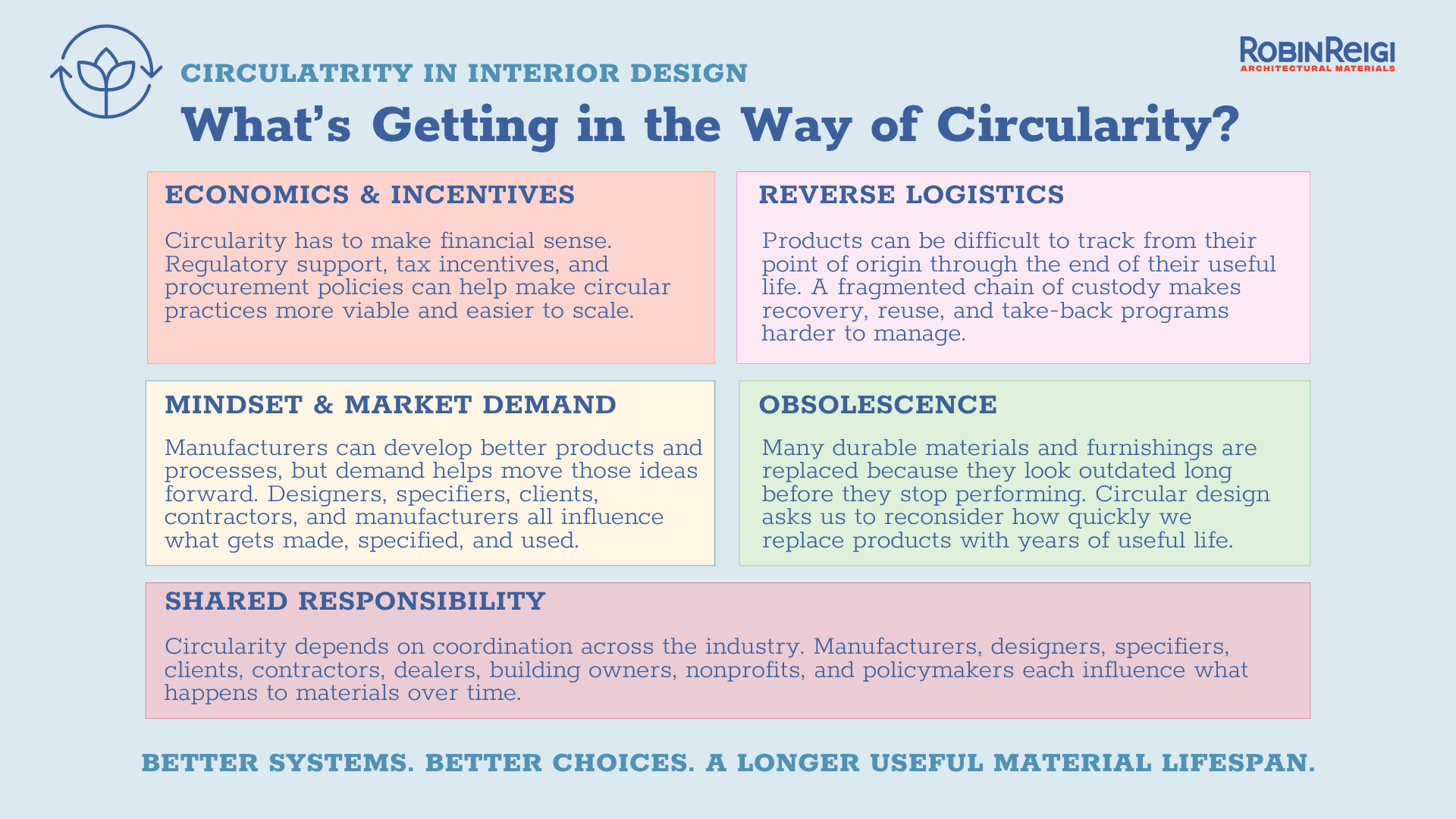
Across those conversations, five challenges stood out: economics and incentives, reverse logistics, market demand, premature obsolescence, and shared responsibility. Each affects a different part of the material lifecycle, and each requires industry-wide cooperation.
“What struck me most was how similar the challenges were across very different manufacturers."
Robin Reigi - Founder, Robin Reigi, Inc.
ECONOMICS AND INCENTIVES HAVE TO SUPPORT CIRCULARITY
One of the most consistent concerns was economic viability.
Circular systems require investment. Manufacturers may need to redesign products, change manufacturing processes, or develop new recovery programs. They may need additional storage or transportation capacity. Some systems require tracking technology or new partnerships. Those investments have to make financial sense.
Government incentives can help. Tax policies can help as well. Procurement requirements can also create demand for products designed around circular principles. The market itself plays an equally important role.
When architects, interior designers, developers, and clients prioritize circular products, manufacturers gain a clearer reason to invest. Specification decisions matter because manufacturers respond to demand. The more frequently clients request reusable, repairable, or recoverable materials, the more viable those products become.
REVERSE LOGISTICS REMAINS A MAJOR OBSTACLE
Getting a product into a building is relatively straightforward. Getting it back can be much harder.
Interior materials often move through a long chain before installation. Manufacturers work with distributors and dealers. Contractors and installers become involved. Building ownership can change. Tenants may come and go. Years later, the original manufacturer may have little visibility into where the product is located. This fragmented chain of custody creates a major challenge for circular interior design.
Take-back programs depend on knowing where products are and when they become available. Someone also needs to remove them, store them, and transport them. Those steps require coordination. Reverse logistics therefore needs to become part of the circular design conversation much earlier. Material passports and better product tracking may help. So can stronger relationships between manufacturers, dealers, contractors, and building owners.
The systems are still developing. The need is already clear.
DESIGN FOR DISASSEMBLY CAN START WITH SIMPLE CHANGES
Some circular design solutions are surprisingly straightforward. One example discussed during the event was the way products are attached.
Permanent adhesives can make components difficult to separate. That can prevent repair or reuse, even when most of the product remains in good condition. Mechanical attachments can provide more flexibility. Magnets, clips, removable fasteners, and hook-and-loop systems let components come apart cleanly. That changes what happens later. You can replace a damaged section without removing an entire installation. Materials can be separated more easily. Components may be reused in another application.
For architects and designers, these details can feel small during specification. Over the life of a project, they can have a significant effect. Design for disassembly begins with thinking about the next use while planning the first one.
“Circularity will move forward when we make it easier for everyone in the chain to participate, from how products are designed and specified to how they are recovered and reused.”
Robin Reigi - Founder, Robin Reigi, Inc.
MARKET DEMAND CAN MOVE CIRCULAR DESIGN FORWARD
Manufacturers can develop new products and processes. The market determines how quickly many of those ideas grow.
Designers and specifiers have real influence here. Asking different questions can change the conversation with manufacturers.
- How is the product assembled?
- Can individual components be replaced?
- Can it be repaired?
- Does the manufacturer offer a take-back program?
- What happens to the material at the end of its first installation?
These questions signal what the design community values.
Clients also have influence. A client who prioritizes material reuse or longer replacement cycles creates opportunities for designers to make different choices.
Contractors and installers matter as well. Their decisions can determine whether products remain recoverable years later.
Circularity works best when the project team understands those priorities.
“Manufacturers can innovate, but the market has to ask for those innovations.”
Robin Reigi - Founder, Robin Reigi, Inc.
THE BUILT ENVIRONMENT HAS A FAST FASHION PROBLEM
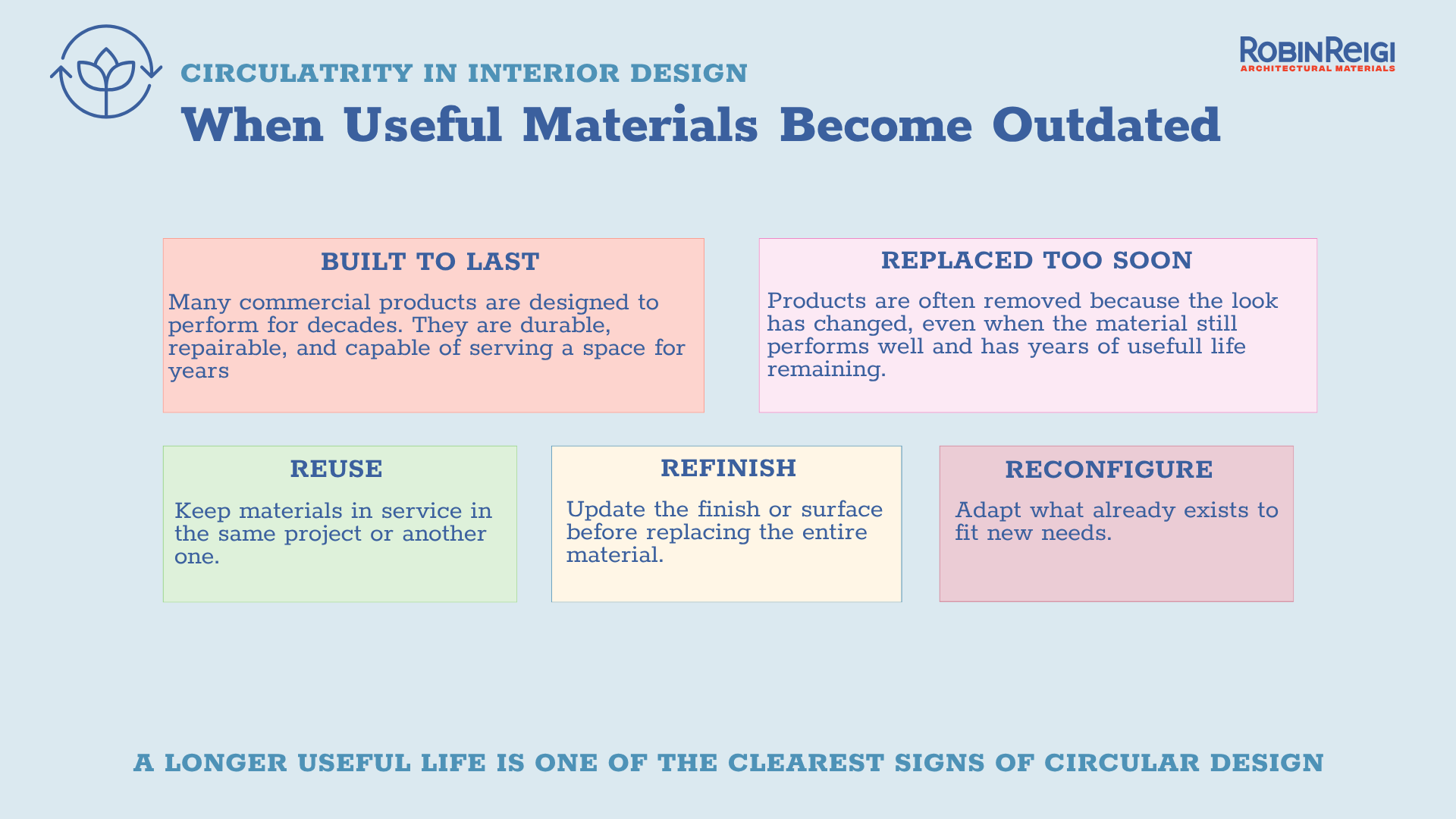
Another topic from the discussion was especially striking. Many interior products are engineered to last for decades. Yet they can be removed after only a fraction of that time.
Often, they still work perfectly well. The problem is aesthetic obsolescence. Workplaces are refreshed. Hotels are renovated. Retail environments change. Furniture and finishes are replaced because the desired look has changed. The product may still have years of useful life remaining. This is where the comparison with fast fashion becomes uncomfortable.
The built environment requires enormous amounts of energy and material. Treating durable interior products as short-term aesthetic choices creates unnecessary waste. Circularity asks us to reconsider the pace of replacement.
- Can a space evolve without stripping everything out?
- Can existing materials become part of the next design?
- Can a product be refreshed rather than discarded?
Designers have always been skilled at imagining what comes next. Circular design expands that skill to include what is already there.
LONGEVITY SHOULD BE PART OF THE DESIGN BRIEF
Designing for longevity changes some familiar priorities. Durability remains important. Adaptability becomes equally useful.
Products that can be repaired, reconfigured, or refinished can respond to changing needs. Timeless materials may remain visually relevant longer. Clients can also benefit from this approach. Extending the life of existing materials can reduce replacement costs. It may also reduce disruption during renovation.
This does not mean every interior should remain unchanged for decades. Buildings need to adapt. Organizations grow and change. Technology evolves. The opportunity lies in designing that change more intelligently. A renovation can preserve useful components while introducing new ones. Furniture can move to another location. Materials can find a second application.
Longer material life should become another measure of good design.
“Circularity also means reconsidering how quickly we decide something needs to be replaced.”
Robin Reigi - Founder, Robin Reigi, Inc.
SOURCE TO SURFACE PUTS REUSE INTO PRACTICE
Robin also shared a new IIDA New York initiative during the discussion. Source to Surface connects companies with surplus commercial furniture and finishes to community-based nonprofits that can use them.
Companies often have quality products left over after renovations, relocations, or showroom changes. Those products may include furniture, flooring, lighting, and applied finishes. Source to Surface connects organizations with available materials to nonprofits that need them.
The idea is straightforward. Keep useful products moving. A desk that no longer fits one workplace may serve another organization for years. The same can be true for chairs, storage, flooring, or other commercial materials.
The program also addresses one of the hardest parts of circularity: finding the next user. Making that connection can keep useful products out of the waste stream.
It is a practical example of circularity at work.
CIRCULARITY DEPENDS ON SHARED RESPONSIBILITY
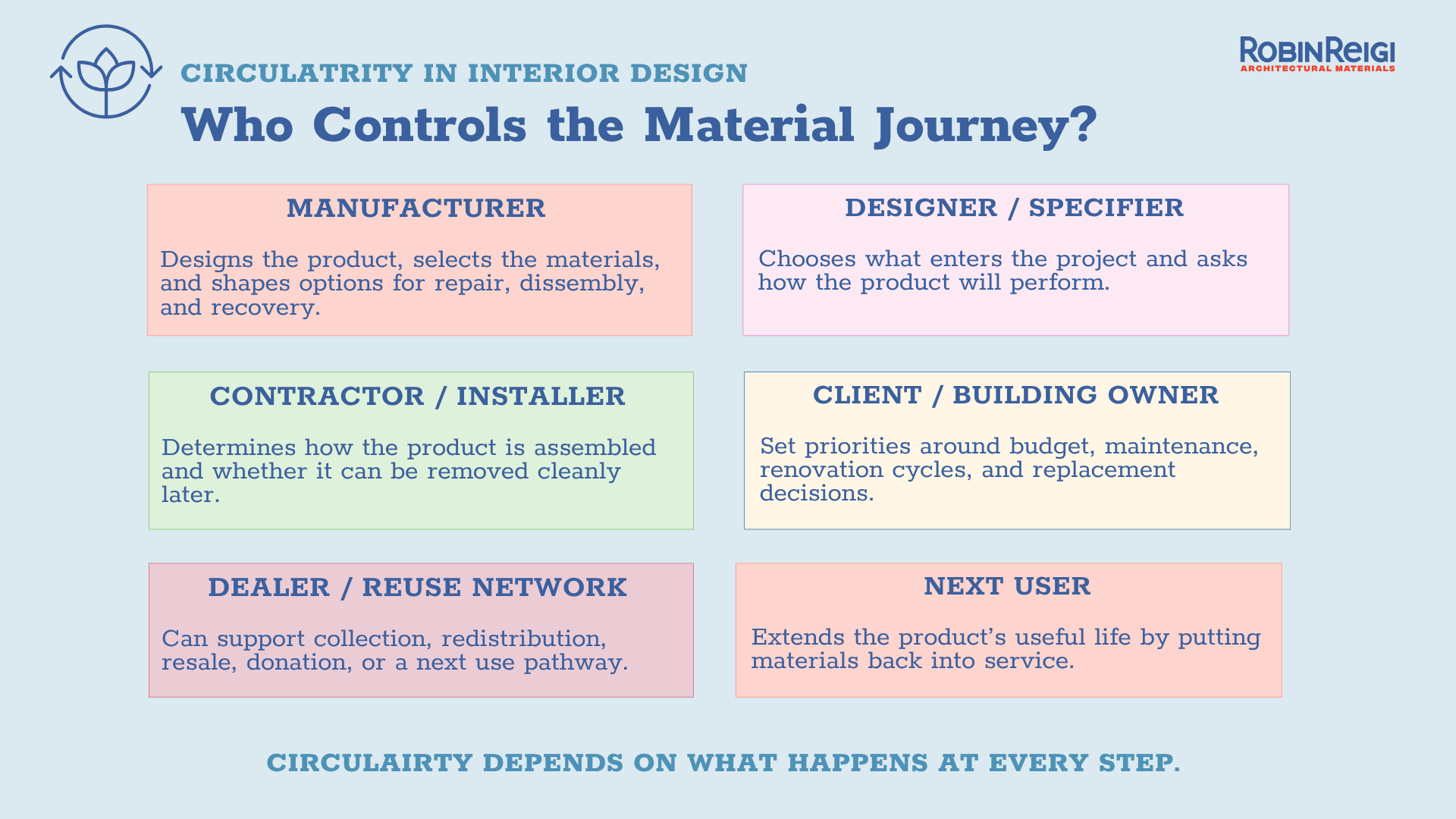
The conversation during Climate Week made one thing clear. No single part of the industry can create a circular system on its own.
Manufacturers influence how products are made. Designers influence what gets specified. Clients influence budgets and replacement cycles. Contractors affect installation and disassembly. Dealers and distributors can help with recovery. Building owners know what is actually inside their properties. Policymakers can create stronger incentives. Reuse organizations can help connect materials with their next users.
Each participant controls a different part of the material journey. That fragmentation creates challenges. It also creates many points where progress can begin. The goal is to connect those efforts more effectively.
ASK BETTER QUESTIONS EARLIER
For designers and architects, one practical step can begin immediately.
Ask more questions before specifying a product. Learn how it is made. Understand how it is installed. Find out whether individual parts can be replaced. Ask manufacturers what they are doing around reuse, recovery, and material health. These conversations help designers make better-informed choices. They also tell manufacturers that circularity matters to their customers.
The answers will vary. Some product categories are further along than others. Geography can affect recovery options. Cost and infrastructure remain real constraints.
Progress will be uneven. That should not prevent the industry from moving forward.
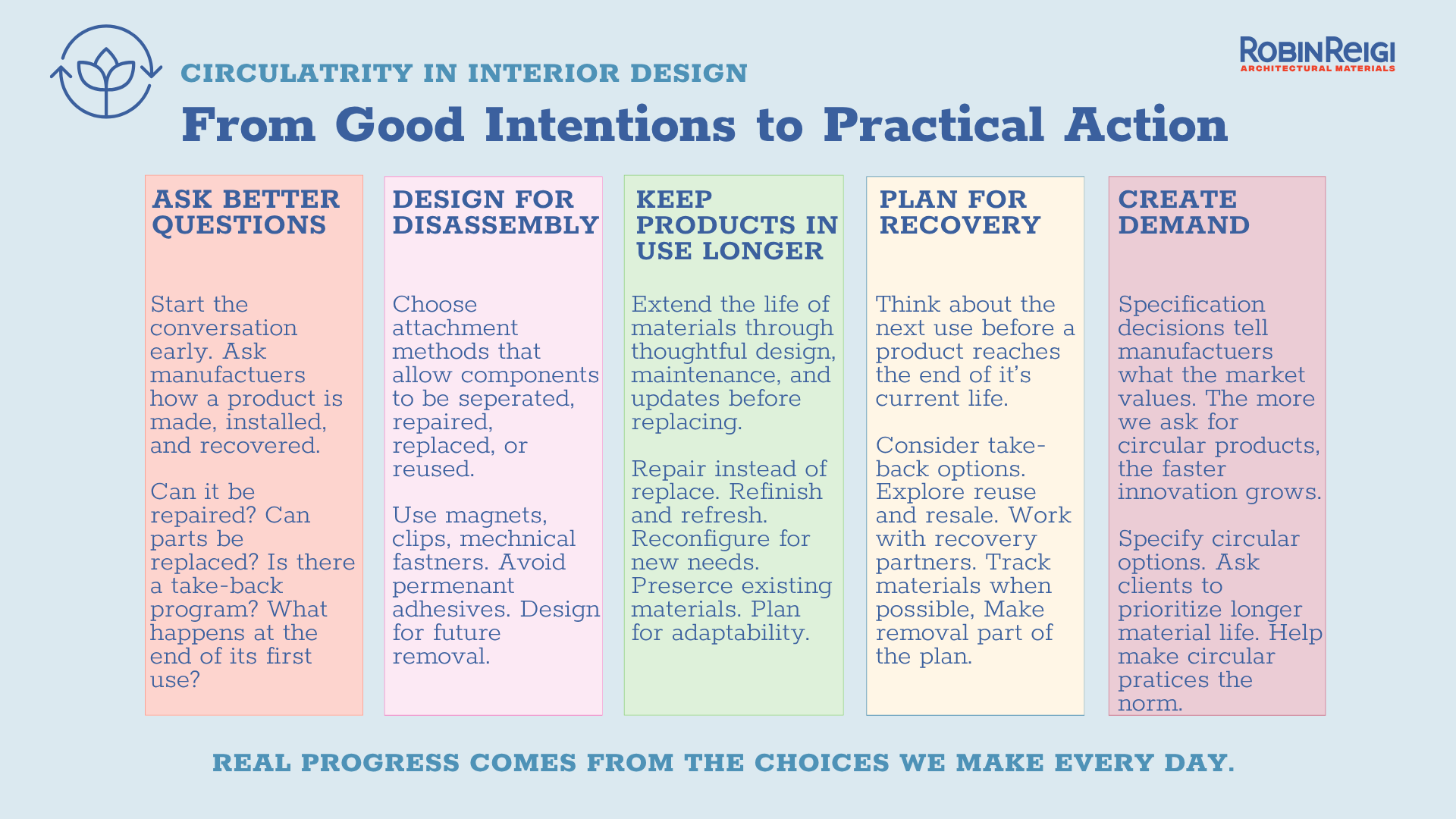
FROM GOOD INTENTIONS TO PRACTICAL ACTION
Circularity in interior design will require new infrastructure and better economic incentives. It will also require changes in everyday design decisions.
Some progress will come from new materials and manufacturing systems. Other progress may come from choosing a removable fastener instead of permanent adhesive. It may come from preserving an existing installation during renovation. It may mean finding another organization that can use furniture a client no longer needs.
Those choices can seem small. Across thousands of interior projects, they add up.
The Climate Week discussion showed how much work remains. It also showed that many people across the industry are already looking for practical ways forward.
Circularity becomes more achievable when we understand a material’s entire life.
- Where did it come from?
- How long can it serve its purpose?
- And where can it go next?
Those are increasingly important design questions. They also offer architects, interior designers, manufacturers, and clients a practical place to begin.